Technology

What Is a Yottabyte? Understanding a Scale of Data Almost Too Large to Picture

Learn what a yottabyte is, how it compares with zettabytes and ronnabytes, how large 10^24 bytes really is, and why yottabyte-scale storage remains a future infrastructure challenge.

What Is a Yottabyte? Understanding a Scale of Data Almost Too Large to Picture

A one-terabyte drive is easy enough to grasp.

You can buy one, put it in a computer, fill it with photos, games, databases, backups, or video, and eventually run out of space.

A petabyte is already harder to picture because it represents a thousand terabytes. Move through exabytes and zettabytes, and ordinary storage devices stop being useful reference points entirely.

Then you reach the yottabyte.

A yottabyte is a unit of digital information equal to 10²⁴ bytes, or 1,000 zettabytes using the decimal units commonly applied to large-scale storage.

Kilobyte    10³ bytes
Megabyte    10⁶ bytes
Gigabyte    10⁹ bytes
Terabyte    10¹² bytes
Petabyte    10¹⁵ bytes
Exabyte     10¹⁸ bytes
Zettabyte   10²¹ bytes
Yottabyte   10²⁴ bytes

The definition is simple.

Understanding what that amount of data would mean in practice is much harder.

How Big Is a Yottabyte?

Start with the number itself:

1 YB = 1,000,000,000,000,000,000,000,000 bytes

That is a 1 followed by 24 zeros.

The same quantity can be written more conveniently as:

1 YB = 10²⁴ bytes

1 YB = 1,000 ZB

1 YB = 1,000,000 EB

1 YB = 1,000,000,000 PB

1 YB = 1,000,000,000,000 TB

That final conversion gives us something closer to hardware people actually encounter.

Put another way, a yottabyte equals one trillion terabytes.

Even at that scale, the number is still mostly theoretical. No single device, and no ordinary real-world storage system, can currently hold a yottabyte of data. The term is more useful as a way to think about future global data growth than as the capacity of something you can actually buy or deploy today.

It is also the kind of number people use to express “effectively everything.” As a mental model, a single yottabyte is often described as enough space for humanity’s accumulated songs, photos, videos, and documents, with plenty of room left over. The exact total depends on formats, duplication, compression, and what counts as worth preserving, but the comparison helps show how far beyond everyday storage a yottabyte sits.

If you tried to provide one yottabyte of raw capacity using 20 TB drives, ignoring redundancy, formatting, failures, spare capacity, and every other practical consideration, the arithmetic would look like this:

1,000,000,000,000 TB


      ÷ 20 TB


50,000,000,000 drives

Fifty billion drives.

At that point, storage capacity isn’t really the only problem anymore. Power, networking, physical space, cooling, hardware replacement, data placement, and the ability to find anything inside the system become enormous engineering problems of their own.

That is what makes the yottabyte interesting.

It isn’t just a bigger disk.

It represents a completely different scale of infrastructure.

How Does a Yottabyte Compare With a Zettabyte or a Ronnabyte?

The easiest way to place a yottabyte is to look at the units around it.

Zettabyte   10^21 bytes
Yottabyte   10^24 bytes
Ronnabyte   10^27 bytes

A yottabyte is 1,000 zettabytes.

A ronnabyte is 1,000 yottabytes.

That means a yottabyte sits between a zettabyte and a ronnabyte in the decimal progression of large storage units. If a zettabyte already describes global-scale data, a ronnabyte pushes another thousand times beyond even that.

You Wouldn’t Build a Yottabyte-Sized Hard Drive

When storage reaches enormous scales, the natural model of “put the data on a disk” stops working.

Large systems distribute information across many machines and storage devices instead.

                     Data

          ┌───────────┼───────────┐
          ▼           ▼           ▼
       Node A       Node B       Node C
          │           │           │
       Storage     Storage     Storage

At much larger scales, those nodes may themselves be organized into racks, clusters, availability zones, data centers, and geographic regions.

This is distributed storage.

The system spreads information across infrastructure so capacity can grow beyond what one machine can hold. Distribution can also provide redundancy and availability, because losing one device doesn’t necessarily mean losing the data stored by the overall system.

The challenge is that distribution creates problems of its own.

Where should each piece of data live?

How do you locate it again?

What happens when a disk fails?

How many copies should exist?

How do you verify that replicas remain correct?

How do you move data when hardware is replaced?

At yottabyte scale, even operations that sound trivial become infrastructure problems.

Cloud Infrastructure Makes Huge Storage Pools Possible

Cloud platforms make large-scale storage feel deceptively simple.

An application might upload an object using an API and receive a successful response:

Application

     │ upload object

Cloud Storage


   Success

From the application’s perspective, the operation is straightforward.

Behind that storage interface can be a much larger system responsible for distributing data, maintaining metadata, detecting failures, replicating or encoding information, balancing capacity, replacing hardware, and serving requests from enormous numbers of customers.

                 Storage API


              Storage Service

       ┌─────────────┼─────────────┐
       ▼             ▼             ▼
    Cluster A     Cluster B     Cluster C
       │             │             │
    thousands     thousands     thousands
    of devices    of devices    of devices

This abstraction is one reason modern applications can handle datasets that would once have required highly specialized infrastructure.

But cloud storage doesn’t make the physical problem disappear.

Somewhere underneath the API, data still has to occupy real storage hardware inside real facilities.

Eventually, the Problem Reaches the Data Center

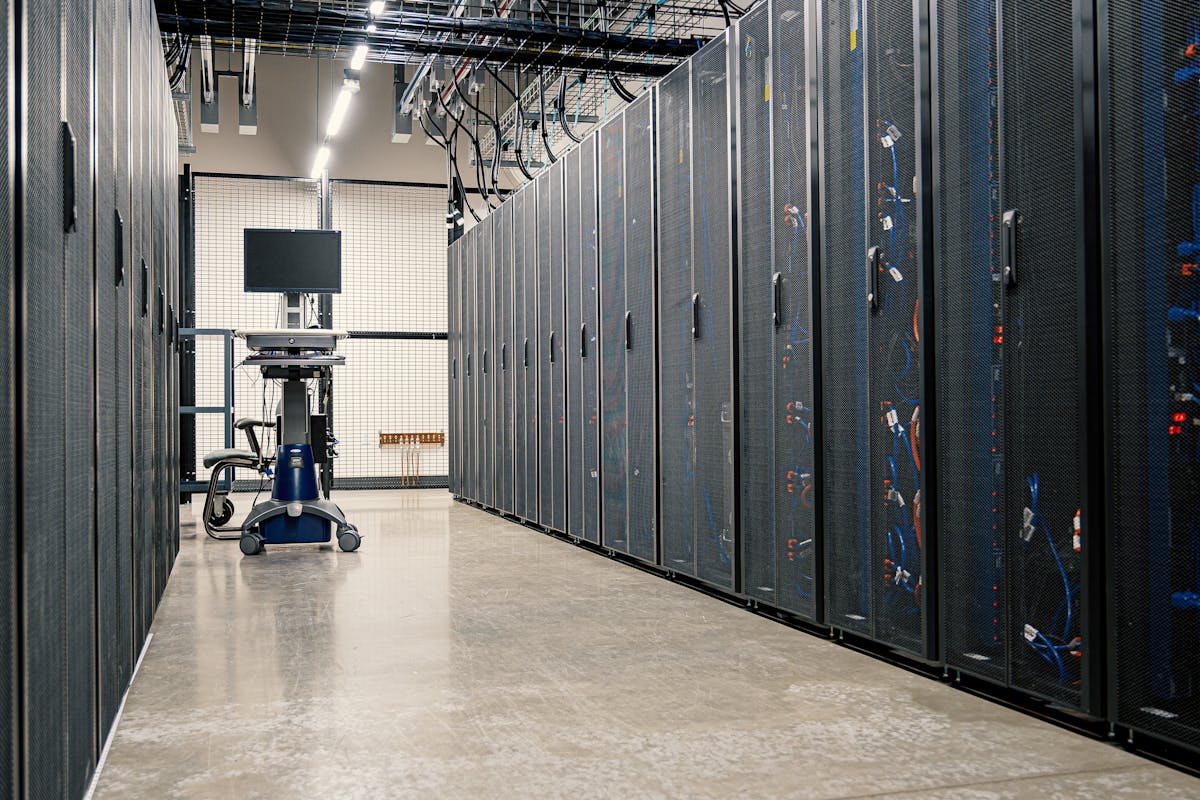
A data center provides the physical environment required to operate large amounts of computing and storage equipment.

Servers need power.

Storage devices produce heat.

Networks need switches, routers, fiber, and physical paths between machines. Hardware fails and needs replacing, while the facility itself needs cooling, monitoring, security, backup power, and connectivity.

Data Center

├── Compute

├── Storage

├── Networking

├── Power

├── Cooling

└── Physical security

How would we scale those requirements toward a yottabyte?

You wouldn’t simply ask how many drives were required. You would need to consider how many racks could hold them, how much electricity those racks consumed, how much heat needed to be removed, and how much network capacity was required to move useful amounts of information through the system.

The physical scale becomes part of the data problem.

This is why massive data storage is inseparable from infrastructure engineering.

Big Data Isn’t Just About Having a Lot of Bytes

The phrase big data is sometimes treated as if it simply means an enormous collection of information.

Volume certainly matters, but the engineering problem is broader.

Suppose an organization has a huge dataset spread across thousands of machines. Storing it successfully doesn’t mean the organization can use it successfully.

Massive Dataset

      ├── Store it
      ├── Find it
      ├── Process it
      ├── Protect it
      ├── Move it
      └── Delete it

A dataset becomes much less useful if querying it takes weeks.

The system therefore needs ways to divide work across machines, keep track of where information resides, process portions of the dataset in parallel, and combine results efficiently.

As data volumes increase, moving the data itself also becomes expensive.

If a computation needs 100 petabytes, repeatedly transferring that entire dataset across a network may be far less practical than moving the computation closer to where the data already resides.

Storage architecture and computing architecture begin influencing each other.

Scalability Changes the Design

A system that works with 10 terabytes won’t necessarily work unchanged with 10 exabytes.

This is where scalability matters.

If we had a storage service that keeps the location of every object inside one metadata database:

Object


Metadata Database


Storage Location

That architecture may work perfectly at a smaller scale.

As the number of objects increases, the metadata service can become the bottleneck. The storage capacity may be distributed across thousands of machines while every request still depends on one overloaded component.

The system then needs to evolve.

                   Request


             Distributed Metadata
                │      │      │
                ▼      ▼      ▼
              A-M     N-S     T-Z
                │      │      │
                ▼      ▼      ▼
              Data    Data    Data

This pattern appears repeatedly in large systems.

Increasing capacity in one layer exposes limitations somewhere else. More disks require more metadata management. More machines require more networking. More replicas require more coordination, while more users create more requests.

Scaling storage is therefore not the same thing as simply attaching more drives.

Managing the Data Becomes as Important as Storing It

At extreme scale, organizations can’t treat every byte identically forever.

Some information is accessed constantly. Some is needed occasionally. Other data exists only because a retention policy requires it to be preserved.

That creates a data management problem.

Incoming Data


   Classify

 ┌────┼─────────┐
 ▼    ▼         ▼
Hot   Warm      Cold
 │    │         │
 ▼    ▼         ▼
Fast  Lower   Archive
tier  cost     storage

Frequently accessed data may justify expensive storage optimized for low latency. Older information can move to cheaper storage where retrieval takes longer.

Retention also matters.

If an organization generates enormous amounts of data but never decides when anything can be removed, storage growth becomes a one-way process.

At sufficiently large scale, keeping unnecessary information isn’t merely untidy. It creates infrastructure, security, privacy, backup, and financial costs.

Good data management therefore includes knowing what should exist as much as knowing where to put it.

Backups Make the Numbers Even Larger

If an organization stores one petabyte of production data, that doesn’t necessarily mean it needs only one petabyte of physical capacity.

There may be replicas, snapshots or backups stored in another system or geographic location.

Production Data

      ├────► Replica

      ├────► Snapshot

      └────► Backup

Each additional copy consumes capacity.

This becomes important when people talk about extremely large storage quantities. “One yottabyte of data” and “one yottabyte of physical storage” are not necessarily the same thing.

If every piece of information requires several redundant copies, the infrastructure required to safely store the dataset can be much larger than the logical size presented to applications.

Backup systems also need to solve another problem: recovery.

A backup that would take years to restore isn’t particularly useful for a system expected to recover quickly.

At large scale, organizations need to think not only about whether a backup exists, but how quickly and reliably the required information can be recovered from it.

Some Data Doesn’t Need Fast Storage at All

Not every byte needs to sit on infrastructure designed for immediate access.

Information that must be preserved for years but is rarely retrieved can move into archival storage.

The tradeoff is straightforward:

Frequently Used Data


Fast Storage


Higher cost


Rarely Used Data


Archive


Slower retrieval / lower cost

Archives can contain historical business records, scientific datasets, media collections, regulatory records, backups, and other information whose value comes from long-term preservation rather than frequent access.

At very large scales, archival decisions become important because keeping everything on the fastest available storage would be unnecessarily expensive.

The difficult part is predicting what will still matter later.

A dataset that appears unimportant today may become valuable for research or analysis years from now. On the other hand, preserving everything indefinitely creates its own cost and governance problems.

The answer isn’t simply “store more.”

It is deciding what is worth keeping.

Moving a Yottabyte Would Be a Problem by Itself

Storage capacity tends to get most of the attention, but enormous datasets also expose the limits of networks.

Suppose you somehow had a one-yottabyte dataset and wanted to copy the entire thing somewhere else.

Even with an extremely fast connection, the amount of information involved is extraordinary.

Yottabyte Dataset


Network


Another Storage System

The network has to carry every byte.

That makes download time part of the thought experiment too. A full yottabyte is so large that even extremely fast links barely make a dent in it.

At 1 Gbps   ≈ 254 million years
At 100 Gbps ≈ 2.54 million years
At 1 Tbps   ≈ 254,000 years

Those are rough estimates that ignore protocol overhead, retransmissions, storage bottlenecks, and downtime, but they make the point clearly: at yottabyte scale, moving the data can be as unrealistic as storing it.

This is one reason large-scale computing tries to avoid unnecessary movement of data. Replication strategies, geographic placement, caching, local processing, and data lifecycle policies all become partly about reducing transfers that would be expensive or impractical.

The larger the dataset becomes, the more important where computation happens becomes.

At some point, moving the code to the data is much easier than moving the data to the code.

Hardware Failure Stops Being Unusual

If one drive has a small probability of failing during a particular period, you may go years without seeing the failure yourself.

Operate millions of devices and the situation changes.

Failures become normal operating events.

Small System

Drive ──► usually works


Massive System

Drive 1 ──► works
Drive 2 ──► works
Drive 3 ──► FAILS
Drive 4 ──► works
...
Drive N ──► FAILS

Large distributed storage systems therefore need to assume that individual components will eventually disappear.

Data may be replicated across devices or protected with erasure-coding techniques so the loss of individual hardware doesn’t immediately become data loss. Monitoring systems identify failures, and the storage system rebuilds missing redundancy elsewhere.

At enormous scale, reliability comes less from expecting every component to work forever and more from designing the overall system to survive components that don’t.

A Yottabyte Is Also a Future Computing Problem

Today, the yottabyte is more useful for understanding scale than for describing the capacity of an ordinary storage system.

But computing has repeatedly moved into units that once seemed excessive.

Kilobytes became megabytes.

Megabytes became gigabytes.

Consumer storage moved into terabytes while large-scale infrastructure began dealing with petabytes and exabytes.

Past                     Future

KB → MB → GB → TB → PB → EB → ZB → YB

Future computing workloads could continue pushing data volumes upward.

Scientific instruments generate increasingly detailed observations. Connected devices continuously produce telemetry. High-resolution media grows larger, simulations become more detailed, and AI systems can consume enormous datasets while also generating new information.

None of that means every byte produced needs to be stored permanently.

In fact, the opposite may become increasingly important.

As generation becomes easier, deciding what not to store may become one of the central challenges of future data infrastructure.

Global Data Growth Changes What “Large” Means

The useful thing about units such as zettabytes and yottabytes is that the meaning of “large dataset” keeps changing.

A storage capacity that once belonged exclusively to large organizations eventually becomes ordinary consumer hardware. At the same time, global systems produce increasingly large quantities of information through applications, sensors, communication, scientific research, business systems, video, backups, and machine-generated data.

More Devices

     ├──► More Events

More Applications

     ├──► More Data

Higher Resolution

     ├──► Larger Files

More Automation

     └──► More Machine Data


        Global Data Growth

The interesting question isn’t simply when some dataset will cross a particular unit boundary.

It is how computing systems will deal with continued growth.

More data requires scalable storage, but also better indexing, stronger lifecycle management, efficient processing, reliable backups, sensible archival strategies, and infrastructure capable of surviving constant hardware failure.

A yottabyte makes those problems impossible to ignore.

The Number Is Simple. The Infrastructure Isn’t.

Mathematically, a yottabyte isn’t complicated:

1 yottabyte
     =
1,000 zettabytes
     =
10²⁴ bytes

What makes it difficult to consider is everything required to make that storage useful.

The data would need physical infrastructure. That infrastructure would need power, cooling, networking, redundancy, monitoring, and constant hardware maintenance. Distributed systems would need to know where the information lives, while data-management systems would need to decide what remains online, what moves into archives, and what can eventually be deleted.

Backups would consume additional capacity, and simply transferring large portions of the dataset could become an engineering problem of its own.

That is why a yottabyte is more interesting than a very large number.

It shows what happens when massive data storage stops being a question of disk capacity and becomes a question of entire computing systems.

As global data continues to grow, the technologies that matter won’t only be the ones capable of storing more bytes. They will be the ones capable of deciding where those bytes belong, protecting them when hardware fails, processing them without moving everything, and eventually determining which data is worth keeping at all.